Why product design is shifting from fixed flows to goal-oriented experiences
For a long time, digital product design was built around a simple principle: guiding the user through a flow.
This logic shaped much of UX/UI practice: linear journeys, conversion funnels, hierarchical menus, predictable steps, and screens with clearly defined functions. This model is still relevant, especially in regulated, transactional, and operational systems. But with the rise of generative experiences and AI-powered products, it is starting to show an important limitation.
That limitation is this: people don’t think in screens. People think in intent.
They don’t want to “go through step 1, then step 2, and then click confirm.” They want to solve something, compare options, make a decision, produce a result, delegate a task, and save time.
That’s why the central discussion in product design is increasingly moving away from fixed flows and toward designing experiences around intent.
What it means to “design for intent”
Designing for intent means creating experiences that respond to what the user is trying to achieve, not just the path the system was preconfigured to enforce.
This may sound subtle, but it fundamentally changes the design process.
In the traditional model, the main question is:
“What’s the next screen?”
In the intent-driven model, the question becomes:
“What is this person trying to accomplish right now—and what’s the best way to help them get there?”
This shift moves the focus of design:
From interface to outcome
From step sequences to contextual adaptation
From fixed navigation to decision logic
From prescribed tasks to real goals
In generative environments, this becomes even more evident. The system no longer depends only on pre-built screens. It operates through patterns, signals, inference, and context. That means design is no longer just about shaping surfaces, but also about defining how the system understands, prioritizes, and responds.
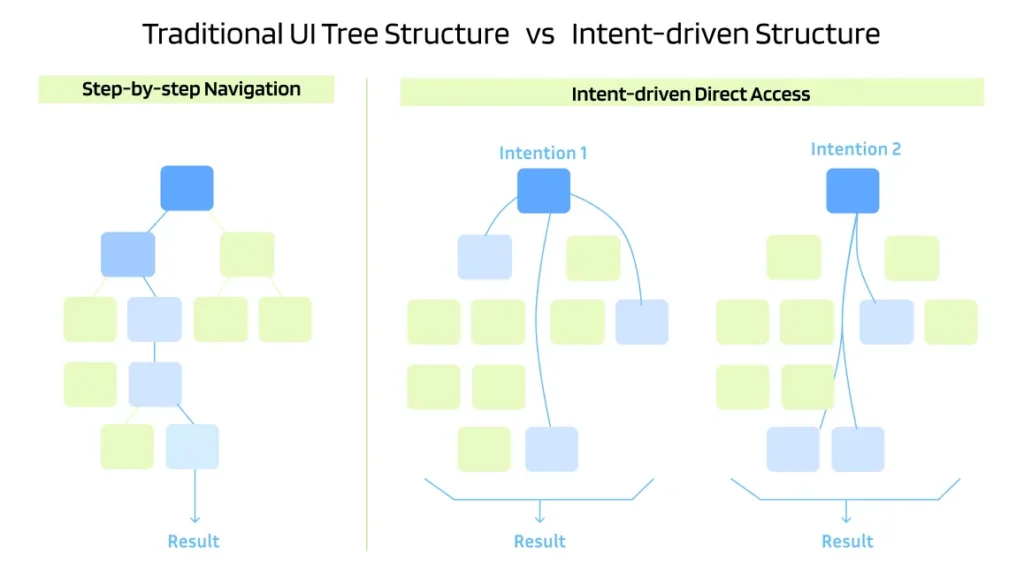
A simple way to understand this shift is by comparing two experience models:
1) Traditional structure (UI tree)
In this model, users navigate through a hierarchy of pages and states to reach a result. It’s step-by-step, predictable, and useful when the ideal path can be defined in advance.
It works well when:
Rules are stable
Scenarios are known
Journey variability is low
2) Intent-driven structure
Here, the system starts from the user’s goal and directly accesses relevant parts of the experience. Instead of forcing everyone through the same path, it can recombine content, prioritize different steps, and adapt responses based on context and intent.
The biggest change isn’t just in the interface. It’s in the experience architecture.
Design now models:
Input signals (what the user says or shows they want)
Decision criteria (what the system should prioritize)
Levels of autonomy (what can be automated)
Validation points (when to confirm)
Recovery mechanisms (when inference fails)
In other words, design expands from shaping the experience to defining the understanding behind it.
Explicit intent and implicit intent
In AI-driven experiences, user intent can be captured in two complementary ways:
Explicit intent
This is when the user clearly states what they want.
Examples:
“I want to generate a monthly report”
“Show me the best cost-benefit options”
“I need to compare plans to subscribe today”
In this scenario, design reduces ambiguity and helps users express their needs through:
Guided prompts
Input examples
Contextual filters
Refinement suggestions
Intermediate confirmations
Implicit intent
This is when the system infers the goal based on behavioral and contextual signals, such as:
Navigation patterns
Action sequences
Recent history
Time spent
Journey stage
Recurring preferences
This increases the power of the experience, but also the risk of error. That’s where design becomes critical: making interpretation transparent and adjustable.
If AI gets it wrong, users must be able to:
Understand what happened
Correct it quickly
Resume without losing progress
Maintain trust in the system
Designing for intent is not abandoning journeys—it’s reframing them
There’s a common misconception that designing for intent means abandoning funnels, journeys, and flows. That’s not the case.
Journeys still matter. The difference is that they are no longer the only dominant structure. They coexist with a more flexible and adaptive layer.
Instead of designing a single ideal path, designers must consider:
Multiple entry points to the same goal
Context variations across user profiles
Different ways to express the same intent
Refinement paths, not just completion paths
This is especially relevant in products where value comes not from completing steps, but from helping users reach decisions, insights, or actions faster.
The four types of intent as a design foundation
A practical way to structure intent-driven experiences is by identifying the dominant type of intent. In digital contexts, four types are common:
1) Informational intent
The user wants to learn, understand, or explore.
Example: “I want to understand the differences between these options”
Design response: clarity, progressive depth, comparisons, explanations, and discovery support.
2) Navigational intent
The user wants to reach a specific destination.
Example: “I want to go straight to that feature”
Design response: direct access, fast recognition, shortcuts, and minimal friction.
3) Commercial intent
The user is evaluating alternatives.
Example: “Which option makes the most sense for me?”
Design response: assisted comparison, clear criteria, contextual recommendations, and evidence.
4) Transactional intent
The user wants to complete a specific action.
Example: “I want to buy / approve / submit”
Design response: speed, confirmation, security, error prevention, and predictability.
This framework helps product teams answer a key question: “What kind of help does the user actually need right now?”
What changes in the designer’s role
When intent becomes the focus, designers move beyond screen design and into more systemic thinking.
This doesn’t replace core UX/UI principles like clarity, consistency, accessibility, and usability. It builds on top of them.
In practice, the scope expands to include:
Intent mapping, not just task mapping
Defining signals for inference
Designing uncertainty states
Deciding when the system should ask vs. act
Transparency strategies
Frictionless error recovery
It also requires closer collaboration with product, engineering, and data teams. Because in intent-driven systems, experience quality depends heavily on how well the system interprets users.
Graceful failure: the most underrated skill in AI experiences
What separates a mature generative experience from one that is merely impressive is how it handles errors.
In inference-based systems, errors are not exceptions—they are expected.
AI may:
Misinterpret intent
Prioritize the wrong context
Suggest something irrelevant
Respond too early with low accuracy
That’s why designing for intent also means designing for graceful failure.
A well-designed system doesn’t need to be perfect. It needs to let users recover control with minimal effort.
Key principles:
Show what was understood
Allow incremental refinement
Ask for confirmation in critical steps
Offer safe alternatives when confidence is low
Preserve progress and context
Metrics: success shifts from screens to outcomes
In traditional experiences, success is often measured by:
Flow completion
Visual consistency
Click reduction
Pattern adherence
These still matter, but they’re no longer enough.
The main question becomes:
Did the experience help the user achieve their goal with clarity, confidence, and less effort?
That requires more behavior-oriented metrics:
Was there progress without hesitation?
Was refinement productive or repetitive?
Did the user complete the action?
Were recommendations used?
Was there abandonment after AI responses?
Did the user revert to manual mode due to loss of trust?
This reframes design evaluation from comparing screens to assessing real value delivery.
Two optimization layers in intent-driven experiences
When an AI experience underperforms, the issue usually lies in one of two areas:
1) The generated experience
The interface may be confusing, poorly structured, or lacking refinement capabilities.
2) Intent inference
The system may misinterpret signals, lack context, or fail to capture intent effectively.
This distinction is critical. Many teams try to fix understanding problems with visual tweaks. But in intent-driven systems, the issue often lies before the interface—in how the system understands the user.
Great design operates in both layers:
Experience layer
Understanding layer
What’s most interesting about this shift
The real power of this shift isn’t superficial personalization. It’s the ability to build products that respond more accurately to what each user actually needs in a given moment.
Different users should experience different paths—not for aesthetic reasons, but for intent alignment.
Explorers need understanding
Decision-makers need comparison and trust
Action-ready users need speed and safety
If we treat everyone the same, we may deliver consistency—but not relevance.
And in AI-driven products, relevance is no longer a differentiator. It’s a requirement.
Conclusion
Designing for intent is not a complete break from traditional UX/UI. It’s a shift in focus.
Flows, journeys, and interfaces still exist. But they are no longer the center of the strategy. They become tools within a broader capability: helping systems understand goals, adapt responses, and drive outcomes.
This shift requires designers to expand their role:
From screens to logic
From navigation to interpretation
From assumptions to understanding
In the end, the biggest change isn’t technological. It’s mental.
We are moving from designing what users see to designing how systems understand.
And that changes everything.
References: NNGroup Generative UI and Outcome-Oriented Design, Design bootcamp Jobs-to-Be-Done and Intention Mapping: Translating Human Needs into Agent Actions, Agentic ux Mapping User Intent to Prompt: AI-native design experience
Senior Principal UX/UI Designer at Zallpy, with over 13 years of experience combining strategy, design, and engineering to build scalable, results-driven digital products. He currently serves as Senior Principal UX Design Engineer at Zallpy, leading the consultative and strategic UX practice with a focus on DesignOps, Design System governance, quality metrics, and maturity assessments. He works closely with executive leadership, product, and engineering teams, facilitating Lean Inceptions, usability and accessibility testing, and post-delivery analyses, consistently connecting user experience, operational efficiency, and real business impact.
Senior Principal UX/UI Designer at Zallpy, with over 13 years of experience combining strategy, design, and engineering to build scalable, results-driven digital products. He currently serves as Senior Principal UX Design Engineer at Zallpy, leading the consultative and strategic UX practice with a focus on DesignOps, Design System governance, quality metrics, and maturity assessments. He works closely with executive leadership, product, and engineering teams, facilitating Lean Inceptions, usability and accessibility testing, and post-delivery analyses, consistently connecting user experience, operational efficiency, and real business impact.




 Verified Author
 Verified Author